Showing posts with label movies. Show all posts

Thursday, October 2, 2014

Teaser Trailer for Pixar's New Film

The teaser poster and trailer for Pixar's new film, 'Inside Out,' has been released!


I typically try not to watch trailers at all since they tend to give too much away, but teasers are usually fine. Of course, there's not that much to say about it yet either, except that this looks intriguing and that the premise is pretty bold - I'll be curious to see how they pull it off for an entire movie. Here's the film's writeup from Pixar:

Growing up can be a bumpy road, and it’s no exception for Riley, who is uprooted from her Midwest life when her father starts a new job in San Francisco. Like all of us, Riley is guided by her emotions – Joy (Amy Poehler), Fear (Bill Hader), Anger (Lewis Black), Disgust (Mindy Kaling) and Sadness (Phyllis Smith). The emotions live in Headquarters, the control center inside Riley’s mind, where they help advise her through everyday life. As Riley and her emotions struggle to adjust to a new life in San Francisco, turmoil ensues in Headquarters. Although Joy, Riley’s main and most important emotion, tries to keep things positive, the emotions conflict on how best to navigate a new city, house and school.

'Inside Out' is due in theaters June 19, 2015.

© Gina Florio 2014

Thursday, May 1, 2014

The Creative Process


We watched 'Adaptation' last weekend... I hadn't seen it since I was in highschool... what a phenomenal movie. In my mind, there is no better film about the act of creating art. Although feel free to challenge me on that...

© Gina Florio 2014

Tuesday, February 25, 2014

Why You Fail

I wanted to take a moment today to talk about self confidence.

Everyone, no matter what profession, has heard that the key to success - socially, at your job, and in life - is to "believe in yourself." When I was younger, I found this cliché phrase to be incredibly insufficient advice. "Believe in myself"? What does that even mean? Why do I feel like I'm being true to myself but I'm still not accomplishing all of my goals at the drop of a hat?

What I didn't understand is the deeper meaning of what this phrase is getting at: it's not about refusing to change, or being unapologetic for your personality. In fact, at least to me, it's almost exactly the opposite. It's about having the right mindset.

I was still confused about this phrase a few years ago when Dave and I decided to watch Star Wars Episode V: The Empire Strikes Back on some random night (like you do). And when we did, this scene spoke to me on a level that it certainly hadn't when I first saw it as a kid.


I know I'm an uber-nerd for saying this, but seriously, there is so much wisdom in this one little scene that's applicable to art AND to life. I may even argue that it's the best scene in the original trilogy.

I felt very challenged in Digital Painting class last week when we went from our first assignment, a greyscale painting of some white objects and their shadows, to our second, a (still grayscale) master study. I found myself complaining in my head that this second assignment was so much harder and thinking we were moving too fast. But really it's "no different... only different in your mind." I didn't believe that I had the ability to finish it. And "that is why you fail."

I think a more accurate (although still cliché) phrase is "You can do anything you set your mind to." Because it involves setting your mind to it. It involves being willing to fail and having determination. But most of all, it involves believing that what you want to accomplish is actually possible. Because if you don't think it is, then you've lost before you've even begun.

© Gina Florio 2014

Friday, July 12, 2013

HTTYD 2 Teaser Trailer Released

Two blogs in one day??? Can it be?!?! YES IT CAN, because the teaser trailer for the sequel to MY FAVORITE MOVIE was just released. Do yourself a favor and watch it like I did - in an empty room, fullscreen, in HD, with the sound way... way up.


Seriously... my excitement for this borders on maniacal.

© Gina Florio 2013

Friday, May 24, 2013

Hayao Miyazaki on Good vs. Evil

My wonderful boyfriend David and I agree on most things. We initially bonded over our love of TV shows, videogames and all things nerd. However, we can't seem to come to an agreement on one of my favorite movies, Spirited Away.


Hayao Miyazaki is the cofounder of Studio Ghibli, Japan's premiere animation studio and producer of Oscar-winning Spirited Away, as well as other well-known films such as Princess Mononoke, Nausicaä of the Valley of the Wind, and Howl's Moving Castle. I have always loved his films, but Dave just couldn't get into it. It's true that they are definitely strange movies by standard American film terms.

Miyazaki explains one of the core differences between his films and American films in this wonderfully illustrated little comic. The fact that his characters are usually neither good nor evil is probably my favorite thing about his movies.


That's all from me for the next little while - I'm about to launch into the crazy month of June with a new show to work on, a new art class (!), and TWO trips and TWO sets of visitors. Here's hoping I come out clean on the other side (with more daily sketches to show for it)!

© Gina Florio 2013

Friday, March 15, 2013

One Year of Art

Before you read: This is a very long, personal post... I wrote it because I've been concentrating on art and drawing for about a year now, and I'd like to have a record where I am at this place in my life. Feel free to skip it if you're just here for the art and links to other things.

I can't pinpoint an exact date that I started on what I will just be totally cheesy and call "my artistic journey." But I know that it started around this time last year, in mid-March.

Of course, I could also say that it started when I was born. When I was little, I drew all the time, during school, after school, on every piece of paper I could find. I could entertain myself for a good few hours if someone set me up with crayons and paper. For career day in third grade where we had to dress up as our role models, I went as Marie Curie. [HUGE EDIT: Wow, don't know how I did that... I meant to say MARY CASSATT. Wow. Anyway.] There was no doubt in my mind that I was going to be an artist when I grew up.

It's a little hard to say exactly what happened. I started writing and illustrating my own "books" in third or fourth grade, and I discovered I really loved writing stories. In late middle school and high school I was still drawing, but I started to focus more on writing. I also started reading a lot of graphic novels at this time - I particularly remember Blankets, Bone, Maus and Persepolis. I started to see how words and images could really work together to tell a story.


In tenth grade, within a few months of each other, I saw the films Garden State and Lost In Translation. Those movies opened my eyes to the kinds of stories you could tell with a film. I began to see movies as the ultimate medium. They can combine every single form of artistic expression - images, words, music, and the fourth dimension of time - pacing - to tell a story. I decided that year to go to school to study screenwriting.


I attended Emerson College in Boston, and in one of my very first classes there, I had to produce a short video. I don't even remember what it was about - but I remember going to the computer lab to edit it on whatever version of Final Cut Pro was around in 2006. And I remember looking at the time on the computer screen and being shocked to realize that 6 hours had passed. On that day, I discovered I loved to edit. I loved determining the particular sequence of images and the pacing of the story. I changed my major to post-production in sophomore year and never looked back. I stopped focusing on writing. I also pretty much stopped drawing altogether.

I worked really hard in college. I wasn't a partier. I did lots of internships and extracurriculars on top of my classes, basically living and breathing editing, and loving it. But after I graduated in 2010, I got a job, I found an apartment, and I sort of... started to coast, a bit. I was enjoying my newfound free time on evenings and weekends, spending my (also newfound) spare money. I remember thinking that I had worked really hard and now it had paid off, and I deserved to just enjoy this time, going shopping, hanging out with friends, playing videogames, watching TV. I was relaxed and happy. But of course, after a couple of years, I started to get restless. I wasn't sure what was wrong with me. I thought, I have it so great! Why am I so unhappy? I realized that there was no longer anything driving me. While I was in school, I always had a goal I was working towards - good grades, getting into college, choosing a major, finding a job. Then, suddenly, I found myself with a job, an apartment, a great boyfriend... I had it all. I had everything I'd been striving for my whole life. Almost like Inigo Montoya at the end of The Princess Bride, I was at a point of... what now?


I tried a lot of things to fill the gap. I started running. I watched Youtube videos about how to do your hair in certain ways (and almost always failed at accomplishing them). I basically replaced my entire wardrobe. I even dabbled with drawing here and there, but always hated what I drew (without, of course, having the rational thought that maybe I needed to LEARN first before I got better). In early 2012, I was at my lowest point. I was feeling extremely unfulfilled by work. I remember a few weeks where I spent the majority of my free time just trying to find the best free phone games to entertain myself with during downtime.

But then one day, in March of 2012, I was on Reddit (as per usual) and came across a link to this post on someone's blog. I still don't know who Josh Beswick is, and I still don't know what it even was about that particular post, but when I read it, it was like a switch flipped in my brain - I immediately knew: I need to learn how to do this. I need to have the ability to make images like that.


I went a little bit overboard at first. I started buying more art books than I would ever have the time to read. I started reading more art blogs than anyone has any business reading. (I read the entire, fairly extensive, backlogs of Gurney Journey, Deja View, and the Character Design Blog.) And I started researching off-hours art classes, more than I could ever afford to take. I started drawing more, and still hated what I was drawing, and lamented it all the time. I'm pretty sure Dave thought I had gone slightly insane.

After six frustrating months of trying to learn on my own, I started taking VisComm 1 at the Concept Design Academy in October 2012. And the rest is pretty much history - I've been keeping the blog since then.

It's been a bit of a whirlwind year. I'm happy to say that I think I've improved at least a little. More importantly, I've learned that improvement takes a lot of time and conscious effort, so I don't get as fed up with failure anymore - I try to learn from it and move on. And I'm pleased to say that I no longer feel bored or restless. Ever. There's too much to learn and not enough time in the world to learn it in. But lately I've been struggling with an entirely new big question - now that I have this passion and drive again, what am I going to do with it?

I still love editing. I'm still very passionate about the act of storytelling, which is what editing IS (especially in reality TV, where the story is usually created in post!!). However - almost no one who takes classes at Concept Design Academy or 3kicks is taking them just for fun. They're taking them because they want to be concept artists and character designers. Many of them already are working in the entertainment design industry but are just trying to improve their skills. And so people in my classes will ask me what my goal is, and I will say... I'm not sure. I always give sort of a waffle-y answer about how I enjoy art but I also enjoy my current job. And the general response is usually surprise. They'll look at me strangely and say something like "you seem more serious than that."

And it's true. I am more serious than that. In January I took the time to listen to Bobby Chiu's "The Perfect Bait," and the free portion of Noah Bradley's "The Art of Freelancing." And both of those things, coupled with the amount of time I've now spent doing this, made me realize - I want to do this. I want to make my living as an artist. And I need to say that I want it. I never want to say it aloud because I am so fucking terrified of failure. But I need to start saying it. I think storyboarding or concept designing would be a great career path. And more importantly, I think I'd be good at it, if I got my artistic skills up to snuff.

There's a lot of stuff I'm scared of. Mainly I'm scared of being too old, and everything that comes with that. But despite that... I know what I want to do. And I have to start being honest with myself about what I want, because otherwise I'll never get it. I want to work as an artist in the entertainment industry. And I'm going to try my hardest to do it.

Wednesday, March 6, 2013

The Scared is scared

So many relatives drew my attention to this online short film today that I eventually just had to watch it. In the film, in very meta fashion, soon-to-be graduating film student Bianca Giaever asks her six year old cousin what to make a movie about, and then goes on to animate/shoot what he says. The result is not only delightfully adorable, but a great example of simple, cohesive design through and through on the part of the production.


Childrens' ability to just make up stories on the spot is unrivaled by any adult. I wish we all retained such natural carefree-ness with our creations into adulthood.

Post script: I aim to use the word "swizzling" more. That is not an English word, but it should be.

© Gina Florio 2013

Friday, March 1, 2013

Gabe Newell and JJ Abrams talk films vs. games

The keynote presentation at D.I.C.E. Summit 2013 was given by Star Trek (and now Star Wars) director JJ Abrams (arguably the greatest  filmmaker of his generation) and Valve's Gabe Newell (the greatest game developer of all time. Non-arguably. That one's not up for debate). In this video, two of the world's top storytellers have an entertaining back and forth about storytelling techniques in their respective mediums.


Let's set aside the awesome reveal at the end for just a second and talk about videogames vs. film (one of my favorite subjects as I'm sure everyone knows by now).

In a great documentary from 2012 called Indie Game: The Movie, I heard videogames described as... "The prime combination of all the forms of artistic expression, made interactive." (I can't remember or find the exact quote, but something like that.) And the interactivity is exactly what makes videogames so enthralling. However, it has always bothered me a bit when videogames don't use cutscenes and let the player have control throughout the entire game. This allows for ridiculous scenarios like JJ's first Half Life 2 example, where the player just messes around with a small device while one of the main characters is attempting to relay important plot points. But I know many gamers who groan every time a cutscene interferes with their play time, or who mash the A button throughout every text-based conversation. I suppose that's the risk any time you try to let someone control their own story - most of them are inevitably going to make an imperfect narrative and miss a bunch of stuff. And at the other end of the scale, you can take the control away completely (as in films) and present them with a perfectly crafted story - but then they may not be as invested as they are when THEY control the character. There isn't an obvious middle ground, to me.

I think both videogames and films are great ways to tell stories. And after watching this video, it seems to me that, no matter what format, the best scenes do two jobs at once, such as setup & character exploration - moving the plot forward while simultaneously informing the viewer about something important to the narrative.

And finally, I love that these two men are planning to collaborate on something, whether it be a game, a film, or somehow, both. Whatever it is, I can't wait to see it.

(By the way, D.I.C.E. stands for Design, Innovate, Communicate and Entertain, and it's an annual video game conference. I had to look that up.)

© Gina Florio 2013

Tuesday, February 26, 2013

85 Years of Oscar

Gallery 1988 teamed up with graphic designer and illustrator Olly Moss to create this tribute poster to all the best picture winners throughout the years. Some very cool designs in here! Click the link for a photo gallery of all the statuettes, but I included some of my favorites here.


And they've even updated it with Sunday night's winner...


I enjoyed Argo, but personally I had been holding out a small amount of hope for Silver Linings Playbook - that was the film with the most heart, to me. And let's not even talk about the fact that Brave won over Wreck-It Ralph. Bleh.

Sketch a day update coming soon!

© Gina Florio 2013

Thursday, January 31, 2013

The Future of Art and Entertainment - Part 2

In "Part 1" I talked about how a new virtual reality technology could potentially change the way we experience videogames, film, and "online" activities such as shopping or talking with friends. I think this current drive towards ever more "3D" and "immersive" and "real" entertainment experiences is the symptom of a cultural desire to blur the line between the tangibility of everyday life and the excitement and wonder of our digital lives.

In "Part 3" I'll talk about how this ever-increasing technology relates to art production - but today I thought I'd just share a few examples of art that blurs the line between 2D and 3D in really interesting ways.

3D movies are obviously big right now, but they've been around for a while. I remember going to see the 3D Muppet movie in Disneyworld when I was 5 years old.

"Did someone say cheap 3-D tricks?"

In actuality, 3D movies have existed for almost as long as film itself - the first 3D projection system and viewing mechanism was patented in the late 1890s by British film pioneer William Friese-Greene, and the first 3D camera rig was patented in 1900 by Frederic Eugene Ives. The trend was actually very popular in the early 1950s, and then enjoyed a revival in the 80's and 90's (mostly as an amusement park gimmick) before growing into the big-budget filmmaking technique we are enjoying (or not, depending on your point of view) at the moment. We can buy our own home 3D televisions, sports games and concerts are broadcast in 3D, and filmmakers like Peter Jackson and James Cameron are reportedly never going back to 2D, touting it as "the way forward for film."

For me, working within the tv/film industry, it's cool to hate on 3D as a gimmick used mainly to drive up prices. Generally, if a movie is available in both 2D and 3D, I'll see the 2D version. But in my personal opinion, 3D looks best in animated films. I remember the first really great 3D experience I had was going to see the movie Coraline in 2009.


At one point early on in the movie, Coraline finds a secret passageway to a parallel universe. As she peeks into the hole, that tunnel (pictured above) expands out in front of her, away from the audience, into the distance. I remember gasping out loud when I saw it. It looked like I could walk right into it.

The other really great 3D experience I've had was seeing one of my favorite films, How To Train Your Dragon, in IMAX 3D. The flight sequences were absolutely unreal.


3D film has become almost the norm now. And a new trend is just starting - with December's release of The Hobbit: An Unexpected Journey, we've seen the debut of Peter Jackson's now-infamous 48-frame-per-second high frame rate which critics have derided as looking "sped up" at best, and some combination of a soap opera and a videogame at worst. But the main argument FOR this technology is that it looks more "real" - that it's like you're looking through a window at the scene.

Jackson says: "As a filmmaker, I try to make my movies immersive. I want to draw the audience out of their seats, and pull them into the adventure. We live in a rapidly advancing digital age. Technology is being continually developed that can enhance and enrich the cinema-going experience. High Frame Rate shooting for a mainstream feature film has only become viable in the last year or two, and yet we live in an age of increasing home entertainment. I started shooting The Hobbit films in HFR because I wanted film audiences to experience just how remarkably immersive the theatrical cinema experience can be."

This speaks to the main point that I'm getting at here, which is that the 3D drive in film, the increasing realism of videogame graphics, and the creation of the Oculus device I talked about in my last post are all symptoms of our desire as a culture - and probably, species - to be able to step into another world, to be transported out of the drudgery of our daily lives. We want to be able to live out our dreams and fantasies as if they were real. And our technology is getting closer to doing that every day.

Three-dimensionality and realism is a coveted quality in art as well. In my first art class, VisComm 1, we were taught to approach any object with its full form in mind, drawing "through" the shapes to create a sketch with weight and substance. Now I'm taking Perspective, which is completely based on how we see the world in three dimensions, with vanishing points, horizon lines, foreshortening of planes. Having a drawing look "flat" or "un-lifelike" means you've failed. It takes a rudimentary understanding of geometry and physics to make a sketch look "right."

Recently there's been a bit of a blowback to the 3D movement, at least as far as film goes - people have nostalgia for the days when films weren't so tricked out with flashy upgrades and, in animation, the golden era of traditionally hand-drawn Disney films, before Pixar came along and changed the game with CG animation. A few things I've seen lately have attempted to bring the two together in a way that appeals to everyone. The most obvious example of this is Disney's short film Paperman, which I wrote about back in October, and which was actually just posted online in full a few days ago.


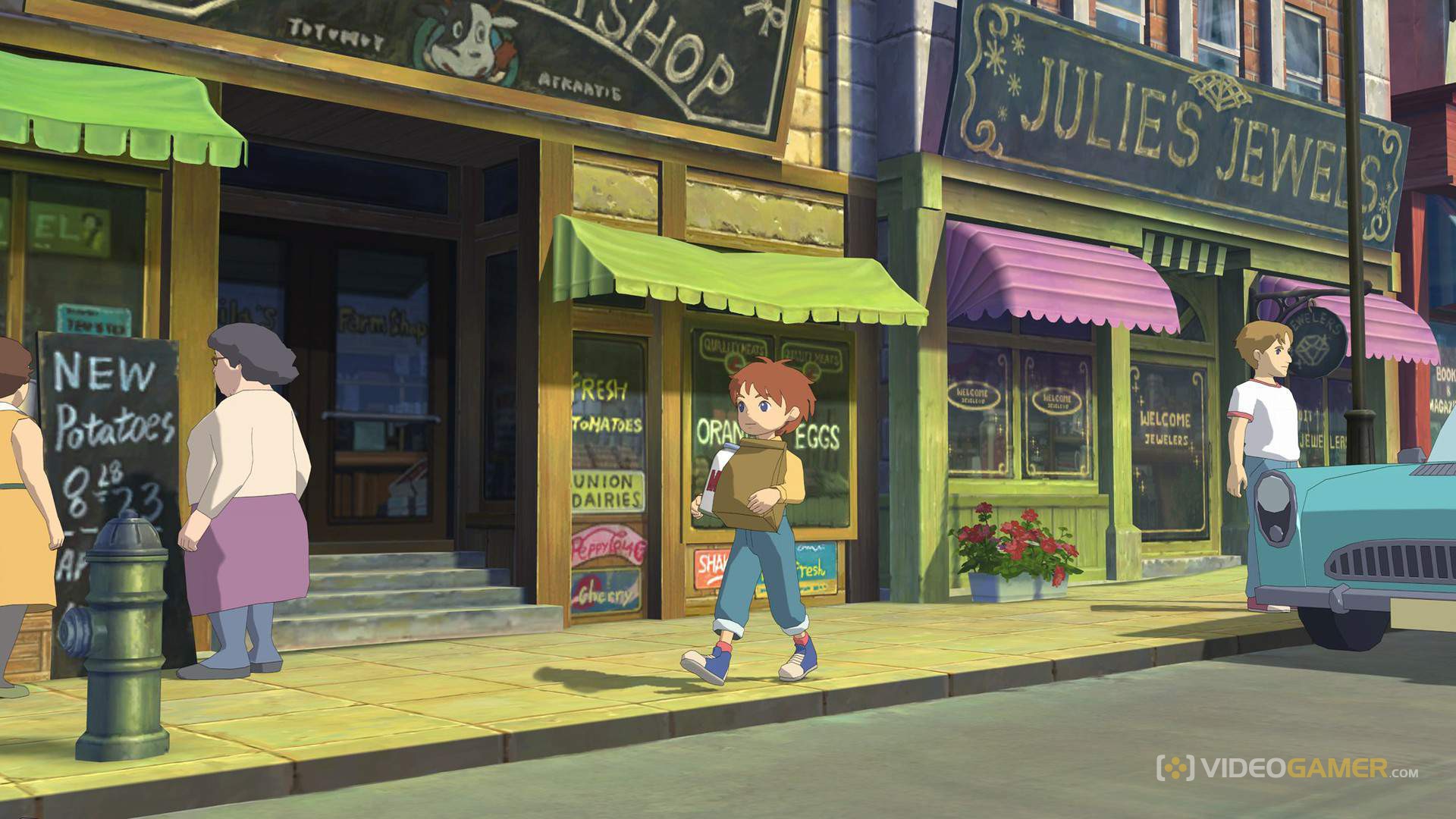
A similar-looking technology is being used in a new videogame called Ni No Kuni: Wrath of the White Witch, developed by LEVEL-5 in collaboration with Studio Ghibli, the film company of the legendary director Hayao Miyazaki. The game looks like his gorgeous trademark 2D anime films - yet the characters and objects operate in three-dimensional space.


(I couldn't find a great gameplay demo video on youtube, but this one on Amazon gives you an idea of how it looks while playing.)

This last example isn't experienced through a screen - an artist called Shintaro Ohata is both a painter and a sculptor, and presents both as part of a whole piece, the sculpture being an extension of the painting and vice versa. His own website says: "He is known for his characteristic style; placing sculptures in front of paintings, and shows them as one work, a combination of 2-D and 3-D world."


I think all this experimenting, this merging of 2D and 3D worlds is a good thing. I personally love what's come from it so far. And I'm excited to see where we go from here.

(Part 3 will be the last in this series and then we can return to our regularly scheduled programming. I'll post a big old sketchdump this weekend.)

Thursday, November 29, 2012

'The Hobbit' Making-Of Video: Post Production

This isn't necessarily art related. Actually it has a lot more to do with editing, which is what I do for a living right now. But you know what?! I'm going to go ahead and share it anyway, yes I am.


Somehow I was unaware that they were even making these 'production diaries,' which is a shame because now I have a backlog of eight 15-minute videos to watch. Anyway, this is a lot like what I do for a living... except about 10,000 times more awesome. (There is some concept art in there though! I had no idea that concept artists stayed on all the way through POST production... a complete revelation to me! Although it makes total sense with such an effects/greenscreen-heavy film.)

To draw a parallel - I feel like a lot of what I've been going through this year, especially how I've become so invested in this drawing thing, has to do with trying to reconcile my personal/artistic aspirations with the place I'm at right now career-wise. I definitely don't want to be editing reality TV forever. BUT I'm also so grateful for this job - and I've made a realization, too. Whether you're a concept artist, a character designer, a screenwriter (my original major in college), a reality TV editor, or the editor of The Hobbit - your job is basically this: storyteller. Almost all creative crafts come back to this - one of the oldest forms of creativity there is. Any book that you read, any art that you look at, any tv show or film that you watch - it affects you because it tells a story that people connect with in some way. You have to know how to make the characters relatable, when to do exposition and when to pull back, what makes a story intriguing. How to create a world that people want to spend time in and know more about. Even a single image or illustration should tell a story, should grab people, make them want to walk into it.

I like my job. I love that it's creative, and I love the act of editing; of finding and putting together the story. I love pretty much everyone I work with. But ultimately I'd just like to work on something I'm passionate about. (Peter Jackson, I know the movie is done, but don't forget you've got two more to make!! I could DEFINITELY pull a few all-nighters for the sake of J.R.R. Tolkein... and I could double as an editor AND concept artist... two employees for the price of one!! Just think about it...)

Wednesday, October 17, 2012

Paperman

From the Character Design Blog, here are some concept sketches and final frames from Disney's new short, Paperman!


I love these - so expressive while being INCREDIBLY line efficient. Simple is best!


 In particular, I love her hair. I always have a really hard time drawing hair. But on any given person, their hair tends to clump together into fairly distinct forms, and the artist simplifies the process by just drawing the outlines of these clumps. At a glance, you can tell exactly what her hair is doing, and it lends movement to the image. For example, in the sketch at the top left of the above image, the way the ends of her hair fan out tell you that she has just spun her head around to look in our direction. In the bottom left sketch, you can tell she has just leaned forward by the way her hair has partially slipped over her shoulder, but the rest is still being held back.

These things sound like no-brainers, but it's little stuff like this that brings a drawing to life.


 I also love that it's in black and white. Sometimes I struggle with getting my sketches to read without using color. But these last few frames are instantly understandable. And also beautiful! Basically, I'm more excited for this short than I am for Wreck-It Ralph (although I'm really excited about that too... way more excited than any self-respecting 20-something should be).

UPDATE 1/31/13: Disney Animation has posted the full short online!! Watch here: