Showing posts with label sculpture. Show all posts

Thursday, March 7, 2013

Attend

The inspiration for this post came from this short documentary on the making of John Mayer's new album cover art. John Mayer, on a long, rambling search for an ephemeral look that he couldn't quite describe, eventually came across David A. Smith from England, who may be one of the last people still doing the meticulous but beautiful work of traditionally hand-painted and lettered signage and glasswork.


While I watched this, I was reminded of a documentary my parents rented when I was in high school called 'Rivers and Tides.' It chronicles the work of Andy Goldsworthy, a Scottish 'sculptor' who works almost exclusively out in nature. His creations are not permanent - they are meant to fade, slowly but surely, back into the wild from which they came. As Goldsworthy says, "Each work grows, stays, decays – integral parts of a cycle which the photograph [of the work] shows at its heights, marking the moment when the work is most alive. There is an intensity about a work at its peak that I hope is expressed in the image. Process and decay are implicit."

It was without doubt the slowest film I have ever seen, in every sense of the word. I'm fairly certain I napped through part of it. But looking back, I think it influenced me a lot. The trailer is below just to give you a sense of his work. (The trailer does its best to convince you it was filmed in the late 70s, but don't be fooled, it was made in 2004.)


Both artists go through an incredibly painstaking process to create beautiful works without ever sitting down at a computer. They must have an extraordinary amount of patience and take extreme care when working, because one wrong move could ruin hours upon hours of work. David A. Smith's medium of choice is LITERALLY as fragile as glass. Because, you know... it is glass. Jokes. Tell everyone you read a hilarious blog today.

Patience, as well as hand-made work, seems to have gone out the window lately. It seems cliché to write about the fast-paced, always-plugged-in world that we live in, but it's true. And yes I appreciate the irony of writing a blog post about this problem. But quality work that takes time and is done by hand is harder and harder to come by. Everyone wants everything as fast as possible.

I was raised Quaker. (Yes they still exist, no they didn't die out, no my family doesn't live on a farm, yes we can use electricity, no my dad doesn't wear a funny hat. You are almost definitely thinking of the Amish, or the guy on the Quaker Oats box.) Quakers are probably best described as the hippie faction of Christianity - they believe in simplicity, solutions through peaceful means, and in "finding the light within," emphasizing a personal and direct relationship with god. The Quaker churches (called 'meetings') I went to also did not have a conventional service. The gathering would generally sit in silence for an hour - basically, group meditation - and if someone had a thought they'd like to share, they could stand and speak aloud. I have fond memories of these services, and believe they taught me the two very important lessons of learning to sit quietly and patiently and turn my focus inwards (probably something I do too much of these days), and also to pay attention to what other people might be thinking or feeling.

Patience is an important thing for children to learn, I think. The name of this post comes from the French word, attend, which literally means 'wait', and which in turn comes from the book I'm reading, Bringing Up Bebé, about an American mother's experience having and raising children in Paris. (NO I'm not expecting children soon, it's just an interesting read.) The French seem to have the child-rearing thing down pat. One among their many great methods is to teach children that instant gratification is just not possible. 'Attend' is said to children all the time, to teach them patience and to help them understand they must be considerate of others before getting what they want.

I am glad to have learned patience so early on. Yet, I'm still certain I would not have the patience to create work on the level of what David A. Smith or Andy Goldsworthy do.

I actually feel quite impatient lately, mostly with my art. I understand why. I realize that I'll probably always have a complicated relationship with my own artwork, but right now the results of my work are so far from the original conception that it's hard not to want to skip to the point where I can just DRAW and have it at least somewhat resemble what I'm thinking about. My skills just aren't there yet. I often catch myself looking for quick fixes. But I think it's good to remember that the journey is of the reward, and that the process of struggling is important. It's how you learn, how you earn the skill.

I may keep a blog, but I also think it's important to step away from the internet, go out into the real world, and do things by hand. (It's Rule #4 in Steal Like an Artist: Use Your Hands. It recommends keeping separate desks for traditional work and for your computer/digital work, if you have the space. Can't wait till I can do that.) I have no doubt that my forgetfulness, impatience, and scatterbrained state of mind lately is caused by my constant proximity to computers and the internet. I've focused on setting boundaries for myself for the past few months to keep distraction at a minimum. I try to remember: Do one thing at a time. Take the time to really look, really think. Have patience. Slow down. Wait.

© Gina Florio 2013

Thursday, January 31, 2013

The Future of Art and Entertainment - Part 2

In "Part 1" I talked about how a new virtual reality technology could potentially change the way we experience videogames, film, and "online" activities such as shopping or talking with friends. I think this current drive towards ever more "3D" and "immersive" and "real" entertainment experiences is the symptom of a cultural desire to blur the line between the tangibility of everyday life and the excitement and wonder of our digital lives.

In "Part 3" I'll talk about how this ever-increasing technology relates to art production - but today I thought I'd just share a few examples of art that blurs the line between 2D and 3D in really interesting ways.

3D movies are obviously big right now, but they've been around for a while. I remember going to see the 3D Muppet movie in Disneyworld when I was 5 years old.

"Did someone say cheap 3-D tricks?"

In actuality, 3D movies have existed for almost as long as film itself - the first 3D projection system and viewing mechanism was patented in the late 1890s by British film pioneer William Friese-Greene, and the first 3D camera rig was patented in 1900 by Frederic Eugene Ives. The trend was actually very popular in the early 1950s, and then enjoyed a revival in the 80's and 90's (mostly as an amusement park gimmick) before growing into the big-budget filmmaking technique we are enjoying (or not, depending on your point of view) at the moment. We can buy our own home 3D televisions, sports games and concerts are broadcast in 3D, and filmmakers like Peter Jackson and James Cameron are reportedly never going back to 2D, touting it as "the way forward for film."

For me, working within the tv/film industry, it's cool to hate on 3D as a gimmick used mainly to drive up prices. Generally, if a movie is available in both 2D and 3D, I'll see the 2D version. But in my personal opinion, 3D looks best in animated films. I remember the first really great 3D experience I had was going to see the movie Coraline in 2009.


At one point early on in the movie, Coraline finds a secret passageway to a parallel universe. As she peeks into the hole, that tunnel (pictured above) expands out in front of her, away from the audience, into the distance. I remember gasping out loud when I saw it. It looked like I could walk right into it.

The other really great 3D experience I've had was seeing one of my favorite films, How To Train Your Dragon, in IMAX 3D. The flight sequences were absolutely unreal.


3D film has become almost the norm now. And a new trend is just starting - with December's release of The Hobbit: An Unexpected Journey, we've seen the debut of Peter Jackson's now-infamous 48-frame-per-second high frame rate which critics have derided as looking "sped up" at best, and some combination of a soap opera and a videogame at worst. But the main argument FOR this technology is that it looks more "real" - that it's like you're looking through a window at the scene.

Jackson says: "As a filmmaker, I try to make my movies immersive. I want to draw the audience out of their seats, and pull them into the adventure. We live in a rapidly advancing digital age. Technology is being continually developed that can enhance and enrich the cinema-going experience. High Frame Rate shooting for a mainstream feature film has only become viable in the last year or two, and yet we live in an age of increasing home entertainment. I started shooting The Hobbit films in HFR because I wanted film audiences to experience just how remarkably immersive the theatrical cinema experience can be."

This speaks to the main point that I'm getting at here, which is that the 3D drive in film, the increasing realism of videogame graphics, and the creation of the Oculus device I talked about in my last post are all symptoms of our desire as a culture - and probably, species - to be able to step into another world, to be transported out of the drudgery of our daily lives. We want to be able to live out our dreams and fantasies as if they were real. And our technology is getting closer to doing that every day.

Three-dimensionality and realism is a coveted quality in art as well. In my first art class, VisComm 1, we were taught to approach any object with its full form in mind, drawing "through" the shapes to create a sketch with weight and substance. Now I'm taking Perspective, which is completely based on how we see the world in three dimensions, with vanishing points, horizon lines, foreshortening of planes. Having a drawing look "flat" or "un-lifelike" means you've failed. It takes a rudimentary understanding of geometry and physics to make a sketch look "right."

Recently there's been a bit of a blowback to the 3D movement, at least as far as film goes - people have nostalgia for the days when films weren't so tricked out with flashy upgrades and, in animation, the golden era of traditionally hand-drawn Disney films, before Pixar came along and changed the game with CG animation. A few things I've seen lately have attempted to bring the two together in a way that appeals to everyone. The most obvious example of this is Disney's short film Paperman, which I wrote about back in October, and which was actually just posted online in full a few days ago.


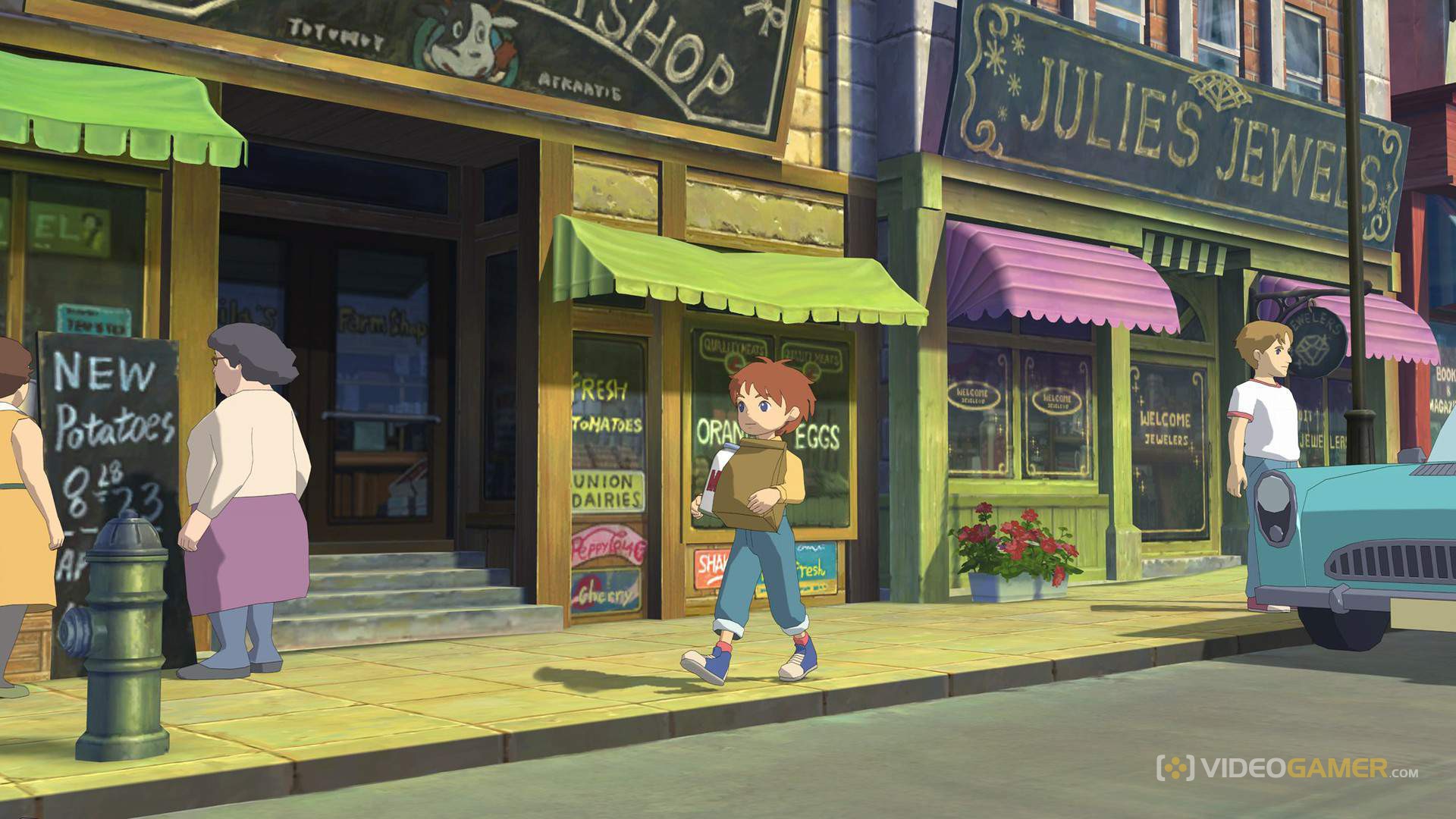
A similar-looking technology is being used in a new videogame called Ni No Kuni: Wrath of the White Witch, developed by LEVEL-5 in collaboration with Studio Ghibli, the film company of the legendary director Hayao Miyazaki. The game looks like his gorgeous trademark 2D anime films - yet the characters and objects operate in three-dimensional space.


(I couldn't find a great gameplay demo video on youtube, but this one on Amazon gives you an idea of how it looks while playing.)

This last example isn't experienced through a screen - an artist called Shintaro Ohata is both a painter and a sculptor, and presents both as part of a whole piece, the sculpture being an extension of the painting and vice versa. His own website says: "He is known for his characteristic style; placing sculptures in front of paintings, and shows them as one work, a combination of 2-D and 3-D world."


I think all this experimenting, this merging of 2D and 3D worlds is a good thing. I personally love what's come from it so far. And I'm excited to see where we go from here.

(Part 3 will be the last in this series and then we can return to our regularly scheduled programming. I'll post a big old sketchdump this weekend.)