Showing posts with label videogames. Show all posts

Tuesday, December 2, 2014

Song of Storms

It's a much-needed rainy day here in Los Angeles - it's been coming down all day! - so what better time to share this delightful piece of artwork I found on the interwebs a little while ago.


I don't often share / showcase individual pieces of art by other artists on the blog, but this one really spoke to me for some reason. I love the style, the lighting / mood, the color palette, all the little narrative elements. It's an illustration that rewards looking closely. The artist is Matt Rockefeller, a recent graduate of the Maryland Institute of Art.

CTN recap coming soon!

© Gina Florio 2014

Tuesday, April 23, 2013

'CosWorld' news / Remastered Super Metroid Screenshot

Despite appearances, I AM still alive and I DO still plan on keeping up the blog and daily sketches... it just might be a bit here and there over the next few weeks. Work has really ramped up and is keeping us pretty busy. The good news is, I'm editing the first show that I'm actually really excited to work on. It's called 'CosWorld,' a docuseries following several well-known cosplayers as they build their costumes and compete at comic conventions around the country. It will premiere on SyFy on August 27 (right after Face Off, one of my favorite reality shows)! Full press release here.

An awesome Zelda cosplay, which is NOT in the show because that would be illegal for me to show you.

Team Rocket... that's right! Also not in the show.

Needless to say, as a huge nerd, I'm very excited about this and have been enjoying my time cutting this awesome footage immensely. I'm also simultaneously disappointed at the number of people in my life who I've explained the premise to and their first question is "What's cosplay?" I tend to forget that not everyone lives in a nerd bubble like myself...

But I digress. Art things!

I came across this video some time ago on Laughing Squid. It's a timelapse of artist TJ Townsend's process 'remastering' a screenshot of 1994 SNES game Super Metroid. Even having never played the game, I got a lot out of watching this video. What's amazing about this artwork is that he didn't draw a single thing - this is all internet found photo manipulation. When I watch videos like these, I'm reminded of what an amazing program Photoshop truly is.


TJ says,
In order to give the screenshot a 16×9 aspect ratio this is not an actual screenshot from the game, but made up of several screenshots and sprite sets. Included in this scene is a metroid, which is not accurate to the game, but believable since there wouldn’t be a logical reason that one could not wander into Mother Brain’s room (And I really wanted to remake the metroid).
Have a great week, everyone - I'll be back as soon as I can!

© Gina Florio 2013

Friday, March 1, 2013

Gabe Newell and JJ Abrams talk films vs. games

The keynote presentation at D.I.C.E. Summit 2013 was given by Star Trek (and now Star Wars) director JJ Abrams (arguably the greatest  filmmaker of his generation) and Valve's Gabe Newell (the greatest game developer of all time. Non-arguably. That one's not up for debate). In this video, two of the world's top storytellers have an entertaining back and forth about storytelling techniques in their respective mediums.


Let's set aside the awesome reveal at the end for just a second and talk about videogames vs. film (one of my favorite subjects as I'm sure everyone knows by now).

In a great documentary from 2012 called Indie Game: The Movie, I heard videogames described as... "The prime combination of all the forms of artistic expression, made interactive." (I can't remember or find the exact quote, but something like that.) And the interactivity is exactly what makes videogames so enthralling. However, it has always bothered me a bit when videogames don't use cutscenes and let the player have control throughout the entire game. This allows for ridiculous scenarios like JJ's first Half Life 2 example, where the player just messes around with a small device while one of the main characters is attempting to relay important plot points. But I know many gamers who groan every time a cutscene interferes with their play time, or who mash the A button throughout every text-based conversation. I suppose that's the risk any time you try to let someone control their own story - most of them are inevitably going to make an imperfect narrative and miss a bunch of stuff. And at the other end of the scale, you can take the control away completely (as in films) and present them with a perfectly crafted story - but then they may not be as invested as they are when THEY control the character. There isn't an obvious middle ground, to me.

I think both videogames and films are great ways to tell stories. And after watching this video, it seems to me that, no matter what format, the best scenes do two jobs at once, such as setup & character exploration - moving the plot forward while simultaneously informing the viewer about something important to the narrative.

And finally, I love that these two men are planning to collaborate on something, whether it be a game, a film, or somehow, both. Whatever it is, I can't wait to see it.

(By the way, D.I.C.E. stands for Design, Innovate, Communicate and Entertain, and it's an annual video game conference. I had to look that up.)

© Gina Florio 2013

Thursday, January 31, 2013

The Future of Art and Entertainment - Part 2

In "Part 1" I talked about how a new virtual reality technology could potentially change the way we experience videogames, film, and "online" activities such as shopping or talking with friends. I think this current drive towards ever more "3D" and "immersive" and "real" entertainment experiences is the symptom of a cultural desire to blur the line between the tangibility of everyday life and the excitement and wonder of our digital lives.

In "Part 3" I'll talk about how this ever-increasing technology relates to art production - but today I thought I'd just share a few examples of art that blurs the line between 2D and 3D in really interesting ways.

3D movies are obviously big right now, but they've been around for a while. I remember going to see the 3D Muppet movie in Disneyworld when I was 5 years old.

"Did someone say cheap 3-D tricks?"

In actuality, 3D movies have existed for almost as long as film itself - the first 3D projection system and viewing mechanism was patented in the late 1890s by British film pioneer William Friese-Greene, and the first 3D camera rig was patented in 1900 by Frederic Eugene Ives. The trend was actually very popular in the early 1950s, and then enjoyed a revival in the 80's and 90's (mostly as an amusement park gimmick) before growing into the big-budget filmmaking technique we are enjoying (or not, depending on your point of view) at the moment. We can buy our own home 3D televisions, sports games and concerts are broadcast in 3D, and filmmakers like Peter Jackson and James Cameron are reportedly never going back to 2D, touting it as "the way forward for film."

For me, working within the tv/film industry, it's cool to hate on 3D as a gimmick used mainly to drive up prices. Generally, if a movie is available in both 2D and 3D, I'll see the 2D version. But in my personal opinion, 3D looks best in animated films. I remember the first really great 3D experience I had was going to see the movie Coraline in 2009.


At one point early on in the movie, Coraline finds a secret passageway to a parallel universe. As she peeks into the hole, that tunnel (pictured above) expands out in front of her, away from the audience, into the distance. I remember gasping out loud when I saw it. It looked like I could walk right into it.

The other really great 3D experience I've had was seeing one of my favorite films, How To Train Your Dragon, in IMAX 3D. The flight sequences were absolutely unreal.


3D film has become almost the norm now. And a new trend is just starting - with December's release of The Hobbit: An Unexpected Journey, we've seen the debut of Peter Jackson's now-infamous 48-frame-per-second high frame rate which critics have derided as looking "sped up" at best, and some combination of a soap opera and a videogame at worst. But the main argument FOR this technology is that it looks more "real" - that it's like you're looking through a window at the scene.

Jackson says: "As a filmmaker, I try to make my movies immersive. I want to draw the audience out of their seats, and pull them into the adventure. We live in a rapidly advancing digital age. Technology is being continually developed that can enhance and enrich the cinema-going experience. High Frame Rate shooting for a mainstream feature film has only become viable in the last year or two, and yet we live in an age of increasing home entertainment. I started shooting The Hobbit films in HFR because I wanted film audiences to experience just how remarkably immersive the theatrical cinema experience can be."

This speaks to the main point that I'm getting at here, which is that the 3D drive in film, the increasing realism of videogame graphics, and the creation of the Oculus device I talked about in my last post are all symptoms of our desire as a culture - and probably, species - to be able to step into another world, to be transported out of the drudgery of our daily lives. We want to be able to live out our dreams and fantasies as if they were real. And our technology is getting closer to doing that every day.

Three-dimensionality and realism is a coveted quality in art as well. In my first art class, VisComm 1, we were taught to approach any object with its full form in mind, drawing "through" the shapes to create a sketch with weight and substance. Now I'm taking Perspective, which is completely based on how we see the world in three dimensions, with vanishing points, horizon lines, foreshortening of planes. Having a drawing look "flat" or "un-lifelike" means you've failed. It takes a rudimentary understanding of geometry and physics to make a sketch look "right."

Recently there's been a bit of a blowback to the 3D movement, at least as far as film goes - people have nostalgia for the days when films weren't so tricked out with flashy upgrades and, in animation, the golden era of traditionally hand-drawn Disney films, before Pixar came along and changed the game with CG animation. A few things I've seen lately have attempted to bring the two together in a way that appeals to everyone. The most obvious example of this is Disney's short film Paperman, which I wrote about back in October, and which was actually just posted online in full a few days ago.


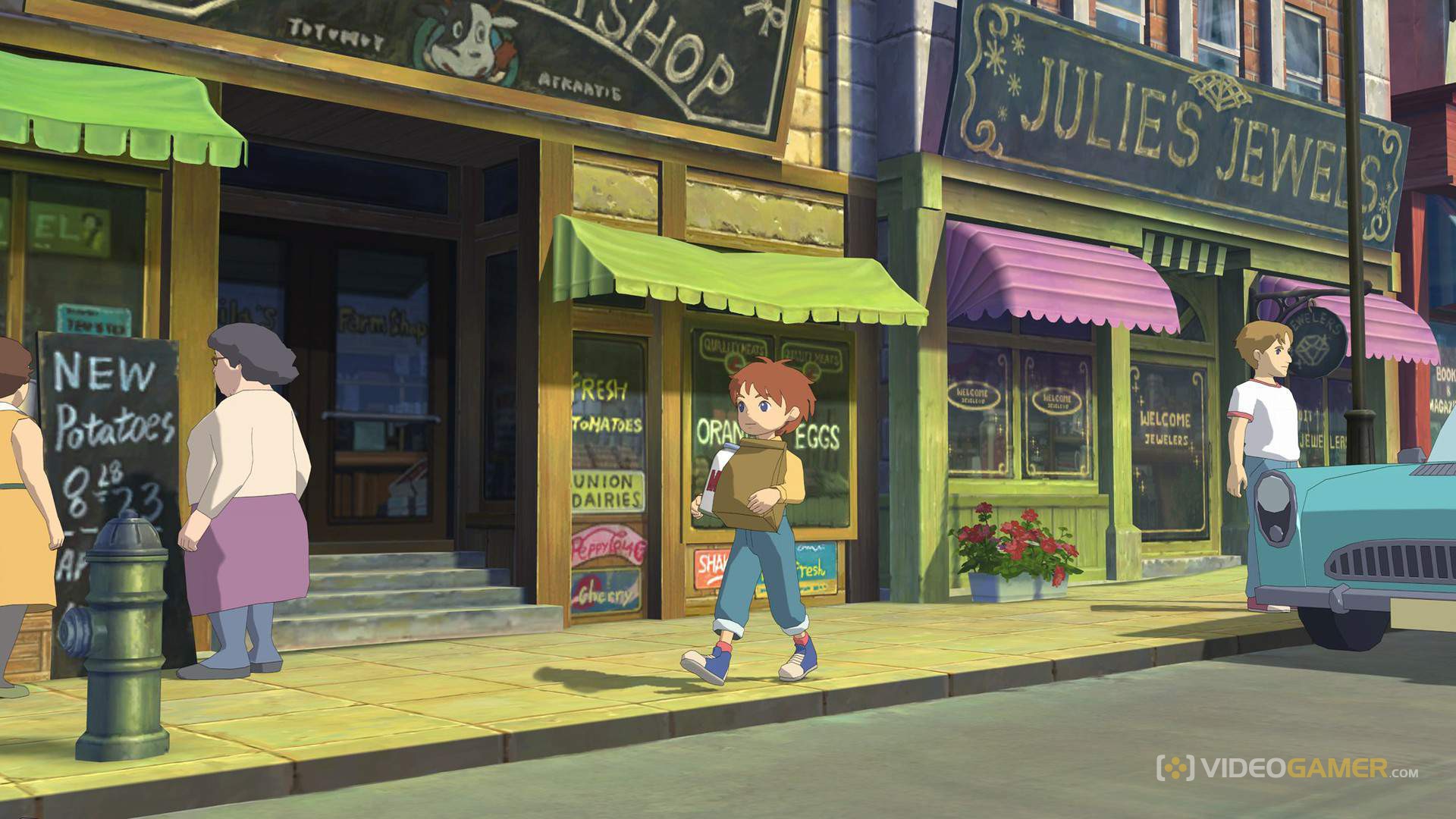
A similar-looking technology is being used in a new videogame called Ni No Kuni: Wrath of the White Witch, developed by LEVEL-5 in collaboration with Studio Ghibli, the film company of the legendary director Hayao Miyazaki. The game looks like his gorgeous trademark 2D anime films - yet the characters and objects operate in three-dimensional space.


(I couldn't find a great gameplay demo video on youtube, but this one on Amazon gives you an idea of how it looks while playing.)

This last example isn't experienced through a screen - an artist called Shintaro Ohata is both a painter and a sculptor, and presents both as part of a whole piece, the sculpture being an extension of the painting and vice versa. His own website says: "He is known for his characteristic style; placing sculptures in front of paintings, and shows them as one work, a combination of 2-D and 3-D world."


I think all this experimenting, this merging of 2D and 3D worlds is a good thing. I personally love what's come from it so far. And I'm excited to see where we go from here.

(Part 3 will be the last in this series and then we can return to our regularly scheduled programming. I'll post a big old sketchdump this weekend.)

Thursday, January 24, 2013

The Future of Art and Entertainment - Part 1

This video is long, basically uncut footage, and the good moments are kind of few and far between... but it's worth watching anyway.


I tell people I'm a gamer all the time and I think of myself in that way - but I've started to realize that in reality, I'm not REALLY a huge gamer. I love videogames. I'm not just saying that just because I think it makes me cool to like them. I actually love videogames in that uncool nerdy way where I can just lose myself in them. I think if I had no self restraint whatsoever I would spend my entire waking life playing videogames. But luckily I'm an adult and I DO have self restraint and playing for longer than an hour now makes me feel guilty. So I'm not really a gamer in that it now takes me about 6 months to finish a videogame. 

All that said - I enjoy games for many reasons - specifically, their ability to transport you to a different world, like a book or film, but UNLIKE books or films, you actually have control in those worlds. You literally get to take control of someone (or something) else and walk them through a story. I love the stretching of the format that's gone on recently, especially with the advent of the indie game movement (See: Portal, Braid, Fez, Limbo...) And I love that, now more than ever, there's more emphasis on the quality of the story and the character development. There's a lot of good things happening in that industry right now. (Not least of which is my little brother being accepted into RIT to study videogame development. Go Jesse!!)

So my initial reaction to this video was excitement. This technology is supposed to become available to consumers next holiday season. If it's as amazing as these reviewers say it is, I see this becoming a widespread gaming norm. (And potentially not just for gaming either - but we'll get to that.) I mean, this is what everyone wants, right? The experience of being IN it. The reviewer's reactions in the video (pointing upwards at the "snow" only they can see, freaking out when an NPC character "walks right by them") reminds me of that story about the Lumière brothers, back in 1895, showing a group of carnival-goers their very first film - "Arrival of a Train at La Ciotat."


When they showed that to an audience of 19th-century people who had never seen a film before, everyone in the theater (apparently) ducked when the train rushed out of the frame. So that's what this new technology would be like for people. I would even say that the entire advent of 3D technology in film is related to this endeavor - people are trying to make entertainment an ever more immersive experience. And consumers want that. They want to be IN it.

My other reaction was... I guess I would say fear? Or at least trepidation about what this means.

Last summer I read a book called "Ready Player One," by Ernest Cline. It was my favorite book I'd read since Harry Potter (apparently I didn't think I was branding myself as enough of a nerd so I'm gonna go ahead and drop that sentence on you). I don't want to spoil anything for anyone, but I'll give you the basic premise - it's set in the future when a technology called the Oasis has become more or less the next internet. It's a virtual reality that people plug into (very much like the Oculus in the above video) and see/experience - everything from shopping, to school, to videogames is done in this giant virtual world. It's so immersive - not to mention addicting - that most of the world's population now spends most of their time in this simulation. And not to sound like a conspiracy theorist or anything, but I can see that happening with this technology.

Maybe not. After all, videogames already exist and are wildly addictive - MMORPGs like World of Warcraft already claim many lives - yet they're still more or less a niche market! That's why consoles like the Wii exist in the first place - to get the average family interested in gaming. But I also think that technology like this has many applications outside of videogames for the average user. (Virtual shopping. Virtual redecoration of your home. Virtual hanging out with friends. Virtual dates. Virtual sex? Some of these things are already happening in WoW or Second Life.)

But also, maybe so. Near the end of the video, the person holding the camera says "this is a digital drug." My favorite part of Ready Player One was actually the end. ---SPOILER ALERT!!!!--- The main character was a teenager who was addicted to the Oasis. But at the end, when he meets the technology's creator, the guy says "I created the OASIS because I never felt at home in the real world. I didn’t know how to connect with the people there. I was afraid, for all of my life. Right up until I knew it was ending. That was when I realized, as terrifying and painful as reality can be, it’s also the only place where you can find true happiness. Because reality is real." And I think that's such an important lesson to learn - but ideally sometime before you're dying. I learned it when I was about 22. I finally bought and installed WoW on my computer - only to uninstall it 3 months later when I realized I was running around doing errands for NPCs in a virtual world when I could be spending time with friends or creating stuff. But had I grown up playing WoW and never learned social skills? I'd probably be playing it right now instead of being gainfully employed, trying to learn to draw, having an active social life, and keeping up a blog.

What does any of this have to do with art? Part 2 of this post will be much more art-centric. But also, I think it's important to note that all kinds of art are related (and videogames are an art form, no matter what Roger Ebert thinks). Painting and sculpture, fine art and comics and concept art, books, television, film and videogames - they're all threads in the huge woven basket of culture, and anything that affects one will affect another.